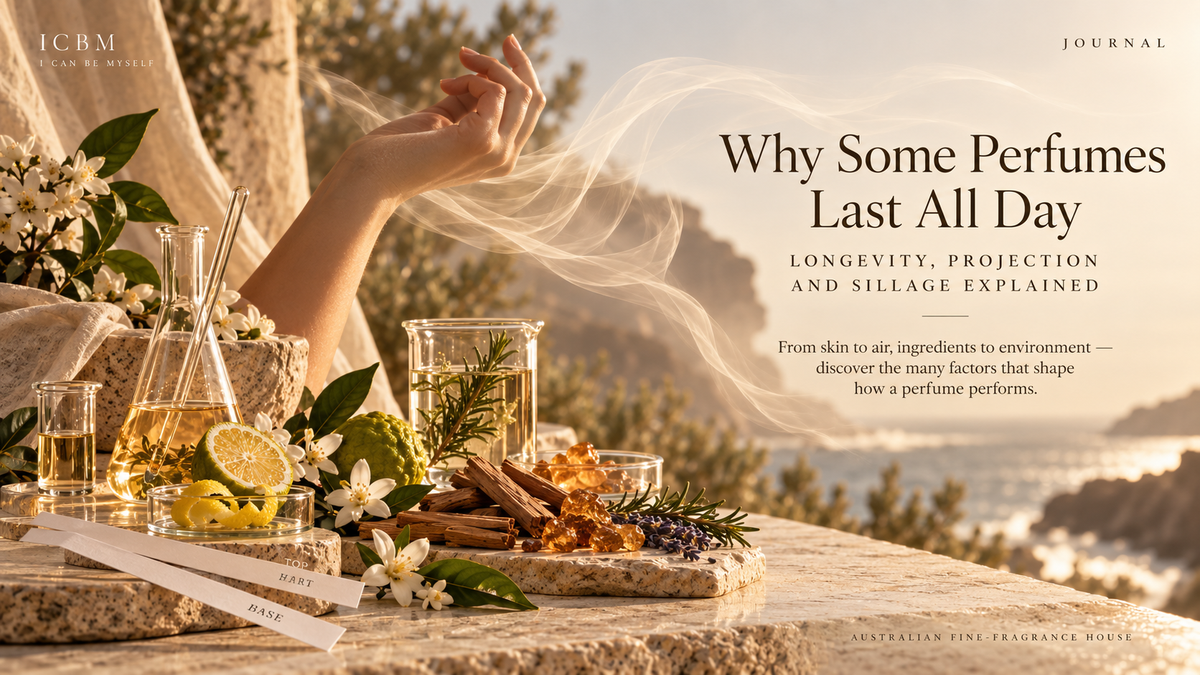
Why Some Perfumes Last All Day: Longevity, Projection and Sillage Explained
Some perfumes announce themselves immediately.
Others seem quiet at first, then remain on the skin for hours.
Some leave a trail through a room but disappear from the wearer surprisingly quickly.
Others stay close to the skin yet can still be detected at the end of the day.
This is why asking whether a perfume is “strong” tells us very little.
Perfume performance is not one measurement.
It is an interaction between the formula, the materials, the concentration, the skin, the air, temperature, movement, application and time.
And perhaps most importantly, longevity is not created simply by adding more perfume concentrate.
A fragrance performs because of its architecture.
What does perfume longevity actually mean?
Perfume longevity describes how long a fragrance remains perceptible after application.
That sounds simple.
In practice, it is more complicated.
A fragrance does not maintain the same intensity from the first spray until the final hour.
It moves.
The brightest materials often emerge first.
The composition then develops as different fragrance molecules evaporate at different rates.
Eventually, the longer lasting materials become increasingly important.
So when somebody says a perfume lasts ten hours, that does not necessarily mean it projects strongly for ten hours.
It may project noticeably for the first few hours and then remain as a softer skin scent much later.
This distinction matters.
Because longevity is only one dimension of fragrance performance.
Longevity, projection and sillage are not the same thing
These three terms are frequently used as though they mean the same thing.
They do not.
Longevity
Longevity describes how long the fragrance remains detectable.
Projection
Projection describes how noticeably the fragrance radiates away from the wearer at a particular time.
Sillage
Sillage describes the scented trail or atmospheric impression created as someone moves through space.
A fragrance can therefore possess significant longevity but moderate projection.
Another can project powerfully during its opening and become much quieter several hours later.
A third may not feel extremely loud close to the skin but produce beautiful sillage when the wearer moves.
There is no universally superior combination.
The correct performance depends on what the perfumer intends the fragrance to become.
Performance begins inside the formula
The most important factor determining perfume performance exists before the fragrance ever touches skin.
The formula.
Every aromatic material has its own physical properties.
Some move readily into the air.
Others remain much longer.
Some create enormous radiance despite being used in relatively controlled quantities.
Others are extremely persistent but stay comparatively close.
This means the perfumer must think about much more than whether an ingredient smells beautiful.
The question is also:
How does it move?
How long does it remain?
What does it amplify?
What does it suppress?
How does it behave beside other materials?
And what happens several hours after the brightest materials have disappeared?
This is fragrance architecture.
Why citrus behaves differently from woods and musks
Imagine opening a fresh bergamot.
The scent seems to explode into the air.
That brightness is part of what makes citrus extraordinary in perfumery.
But many citrus components are relatively volatile.
They move rapidly from the fragrance into the surrounding air.
That creates lift and immediacy.
Many woods, musks, resins, amber materials and other persistent fragrance molecules behave differently.
They may evaporate more slowly and remain perceptible much later.
This difference helps create the familiar development from opening to drydown.
But sophisticated perfumery does not simply place short lived ingredients at the top and long lasting ones at the bottom.
Materials interact.
A radiant woody material can influence the opening.
A musk can alter the texture of an entire composition.
A citrus effect can be extended through less volatile materials that reinforce its impression.
The formula is interconnected.
More perfume concentrate does not automatically mean better performance
This is one of the most important misconceptions in fragrance.
A higher concentration can change richness, persistence, texture and density.
But increasing concentration does not automatically produce greater projection.
Sometimes the opposite can happen.
A dense composition can remain close to skin while lasting for a very long time.
A lighter composition containing highly diffusive materials can create a larger scent cloud despite containing less concentrate.
This is why eau de parfum and extrait de parfum cannot be judged only through percentages.
Concentration is important.
Architecture is more important.
A well designed extrait should not simply smell like someone turned the volume to maximum.
It should use concentration intelligently.
Extrait de parfum and longevity
Extrait de parfum is often associated with richness and persistence because it generally contains a substantial proportion of fragrance concentrate.
But concentration alone does not determine the final experience.
The materials chosen inside that concentrate matter enormously.
An extrait dominated by very volatile materials can behave differently from one structured around persistent woods, musks, resins and amber materials.
The balance between radiance and retention therefore has to be designed.
This is why perfumery cannot be reduced to one simple equation.
More concentrate does not automatically mean better perfume.
Your skin is part of the fragrance environment
A perfume formula may be fixed in the bottle.
The surface onto which it is sprayed is not.
Human skin is biologically and physically complex.
Temperature varies.
Hydration varies.
Surface lipids vary.
Perspiration changes.
The amount of product applied changes.
Even different areas of the same person’s body can create different conditions.
This is one reason professional perfume evaluation cannot stop at the smelling strip.
Eventually, the fragrance has to meet skin.
Does perfume smell different on different people?
Sometimes, yes.
But the phrase “skin chemistry” is often used too casually.
There is not one mysterious switch that completely transforms every perfume.
Instead, there are multiple interacting variables.
Skin temperature can affect diffusion.
Skin surface properties can influence the retention and evaporation of individual fragrance molecules.
The quantity sprayed matters.
The area of application matters.
The surrounding temperature matters.
Air movement matters.
And human perception itself differs.
So the fragrance does not become an entirely new formula on another person.
But the way it is released into the air and perceived can change.
Skin temperature matters
Perfume is constantly moving from the applied surface into the surrounding air.
Temperature influences that process.
Warmer skin can increase the release of volatile materials.
This can make a fragrance appear more expansive or immediate.
It can also mean some parts of the composition move through their development more quickly.
This helps explain why fragrance can behave differently during a cool evening compared with a hot afternoon.
And it is particularly relevant in climates such as Australia, where temperature can vary significantly between seasons and environments.
A perfume is not experienced in a laboratory vacuum.
It is experienced in weather.
The air around you matters too
Fragrance must enter the air before your nose can perceive it.
That means the surrounding air becomes part of perfume performance.
Movement in the air can influence the rate at which volatile molecules are carried away from the skin.
This creates an interesting paradox.
Movement through air can help create a beautiful scent trail.
But stronger airflow can also remove volatile molecules from the immediate skin environment more rapidly.
Perfume performance is therefore not static.
It exists between skin and atmosphere.
Heat, cold and climate
A fragrance experienced in cool weather may feel very different in intense heat.
Warm conditions can increase volatility and diffusion.
Bright notes may appear more immediate.
Heavy materials can become more expansive.
Sweetness can feel more pronounced.
In cooler air, evaporation generally slows.
A fragrance may appear quieter, more controlled or slower developing.
Neither environment reveals the only correct version of the perfume.
They reveal different behaviours within the same formula.
This is another reason fragrance development requires repeated evaluation rather than one smelling session.
Humidity is only part of the picture
Humidity is often discussed online as if it alone explains perfume performance.
Reality is more complicated.
Humidity, skin moisture, perspiration, temperature and airflow may interact, but their effects depend on the materials being evaluated.
So simple claims such as “perfume always lasts longer in humid weather” should be treated cautiously.
Perfume performance is multivariable.
Dry skin and moisturised skin
Many people notice that fragrance seems to disappear more quickly from very dry skin.
Applying an unscented moisturiser before fragrance may change the surface environment and can sometimes help a fragrance remain perceptible differently.
But this should not be treated as a universal performance formula.
Different perfume materials interact differently with different surfaces.
The important point is that fragrance performance is affected not only by what is inside the bottle, but also by where that formula is placed.
Why pulse points are used
Wrists, neck and other relatively warm areas are traditionally associated with perfume application.
The logic is reasonable.
Heat can encourage fragrance materials to diffuse into the surrounding air.
But there is no need to turn perfume application into a complicated ritual.
Good fragrance should perform through its composition.
Application techniques can influence the experience.
They cannot replace a properly constructed formula.
Should you rub perfume into your wrists?
There is a persistent claim that rubbing wrists together “breaks the perfume molecules.”
That explanation is not scientifically meaningful in the way it is commonly presented.
Your wrists are not destroying fragrance molecules simply by touching one another.
However, rubbing can spread the liquid, alter the application area and introduce some additional warmth.
So if you want to observe the perfume exactly as it settles naturally, simply spray it and allow it to dry.
No ritual is required.
Skin versus clothing
Perfume can behave very differently on fabric.
Fabric does not reproduce the same environment as warm living skin.
Certain fragrance materials can remain perceptible on clothing considerably longer because their release conditions are different.
But spraying perfume on fabric also introduces practical considerations.
Some formulas or natural materials may stain delicate fabrics.
Always use caution with silk, light coloured clothing and sensitive textiles.
The skin and fabric experiences should be considered related but different.
Why the same perfume may seem to disappear to the wearer
Sometimes the perfume has not disappeared.
Your perception has changed.
The human olfactory system adapts to continuous stimuli.
When you remain surrounded by the same fragrance for an extended period, your awareness of it can decrease.
Someone entering the room may smell your perfume immediately even though you can barely detect it yourself.
This is one reason repeatedly spraying more fragrance can be misleading.
Your nose is not a perfect performance meter.
Nose fatigue and powerful materials
Certain highly diffusive fragrance materials can create another interesting effect.
A person may become partially adapted to them relatively quickly.
The wearer concludes:
“My perfume is gone.”
The people around them may disagree.
This is especially important when assessing modern woods, musks and amber materials.
Evaluation should therefore include distance, movement, blotters, skin and other people when appropriate.
Professional fragrance assessment requires perspective.
Why performance cannot be measured in hours alone
Imagine two perfumes.
Perfume A creates enormous projection for ninety minutes and becomes barely perceptible four hours later.
Perfume B projects elegantly for several hours and remains detectable on skin twelve hours later.
Which one performs better?
There is no objective answer without knowing the creative intention.
Performance should be assessed across several dimensions.
Longevity.
Projection.
Sillage.
Evolution.
Texture.
Comfort.
Clarity.
Drydown.
And the relationship between all of them.
A fragrance that lasts eighteen hours but becomes harsh after hour three is not automatically superior to one that remains beautifully composed for eight.
Quality and duration are not synonyms.
Why extremely powerful perfume can become tiring
Modern fragrance culture sometimes treats maximum strength as the ultimate measure of value.
That can encourage formulas overloaded with extremely persistent materials.
The result may perform impressively in a simple longevity test.
But excessive power can flatten the fragrance.
Contrast disappears.
Transitions disappear.
Delicate materials become buried.
The wearer experiences one enormous block of scent rather than an evolving composition.
Haute perfumery requires more discipline.
Strength must serve the composition.
Controlled diffusion is a form of craftsmanship
One of the most difficult tasks in perfumery is creating presence without harshness.
The fragrance must leave the skin.
Otherwise nobody smells it.
But it should not need to overwhelm the room.
A carefully constructed perfume can create diffusion through layers.
Brightness draws attention.
The heart expands.
Persistent materials hold the architecture together.
Musks and woods can extend the aura.
Resins and balsamic materials can provide depth.
Radiant molecules can create space around heavier ingredients.
The objective is controlled movement.
Not simply maximum power.
Raw material quality matters
Two materials carrying the same general name are not necessarily interchangeable.
Natural materials can vary according to botanical source, origin, extraction method, processing, age and specification.
Manufactured aroma materials also depend on purity, specification, consistency and quality control.
This matters because perfume formulation is extremely sensitive.
A change in one material can influence several parts of the formula.
Its odour can shift.
Its colour can shift.
Its diffusion can shift.
Its interaction with neighbouring materials can shift.
Its regulatory contribution can change.
This is why serious perfumery looks beyond the name printed on the raw material container.
Why supplier selection matters
A perfume house ultimately depends on the quality of its material supply chain.
The supplier is therefore not simply a company that sends an ingredient.
The supplier becomes part of the fragrance architecture.
At ICBM, our approach is to select fragrance materials and suppliers carefully, looking beyond price alone.
We consider the material’s olfactory quality.
Its consistency.
Its technical documentation.
Its provenance where relevant.
Its processing.
Its traceability.
Its regulatory information.
Its behaviour inside a formula.
And whether it genuinely improves the fragrance.
An expensive ingredient does not automatically earn a place in a perfume.
It has to perform.
Natural and modern materials working together
Luxury perfumery is sometimes incorrectly described as a choice between natural ingredients and manufactured aroma molecules.
That is an unnecessary limitation.
Natural materials can offer extraordinary complexity.
Modern aroma molecules can offer precision, radiance, stability, diffusion and effects that nature cannot provide in the same way.
Contemporary fine fragrance can use both.
The question is not:
Natural or synthetic?
The question is:
What creates the best perfume?
The most expensive material is not always the best material
A rare ingredient can be extraordinary.
But perfumery is not a competition to place the most expensive substances into one bottle.
A beautiful oud can overwhelm an accord.
A magnificent rose can disturb the architecture.
A powerful sandalwood can reduce transparency.
A highly diffusive amber material can dominate everything around it.
The perfumer’s responsibility is therefore editorial as much as creative.
Knowing what to remove can be as important as knowing what to add.
Performance is designed during formulation
At ICBM, longevity is not treated as an isolated number added at the end of development.
Performance must be considered throughout composition.
When we examine a material, we are interested not only in its smell at the moment it touches the blotter.
We are interested in what happens next.
After fifteen minutes.
After an hour.
After several hours.
On skin.
In air.
At close distance.
At greater distance.
During the transition into drydown.
This is where material selection becomes craftsmanship.
The drydown is where architecture is exposed
The opening of a fragrance can be spectacular.
But the drydown is less forgiving.
Once the brightest materials have evaporated, the structure underneath becomes exposed.
Does the perfume still have identity?
Are the woods smooth?
Has sweetness taken control?
Does the musk feel intentional?
Can the original idea still be recognised?
Does the composition remain beautiful when very little is left?
These questions matter enormously.
A serious perfume should survive its own opening.
Maceration does not manufacture longevity
Maceration and controlled resting can help a finished fragrance system integrate as part of appropriate manufacturing practice.
But resting a weak formula for months does not transform it into a powerful perfume.
Time cannot invent missing architecture.
Nor can maceration turn unsuitable materials into ideal ones.
Performance begins with formulation.
Resting supports the fragrance.
It does not replace the perfumer.
More sprays do not create better perfume
Applying more perfume obviously increases the amount of fragrance present.
But beyond a certain point, additional application may reduce the quality of the experience.
Subtle transitions become harder to perceive.
Powerful materials accumulate.
Olfactory adaptation can become stronger.
People surrounding the wearer may experience far more fragrance than the wearer realises.
A well constructed perfume should not depend on excessive application to reveal its identity.
Why luxury perfume should evolve
A fine fragrance should not necessarily smell identical after eight hours.
Movement is part of perfumery.
Citrus may disappear.
Flowers may soften.
Woods may emerge.
A resin may become warmer.
A musk may become more intimate.
What matters is continuity.
The perfume should feel as though it is evolving rather than collapsing.
The final skin scent should still belong to the same world as the opening.
Longevity without beauty is not luxury
A perfume can last an extraordinary amount of time and still be poorly constructed.
Persistence is easy to admire because it can be measured in hours.
Refinement is more difficult to quantify.
It exists in proportion.
Transitions.
Space.
Texture.
Control.
Contrast.
And the way materials support one another.
Luxury is not twenty four hours at any cost.
Luxury is making every stage worth smelling.
The ICBM approach to performance
ICBM approaches perfume as an expression of identity rather than simply a contest for maximum strength.
That means performance has to support the emotion of the fragrance.
Materials are selected not only for their individual beauty, but for how they contribute to the complete architecture.
Naturals can provide complexity.
Modern aroma molecules can provide precision and diffusion.
Woods can give structure.
Musks can create continuity and skin presence.
Resins can provide depth.
Citrus can introduce radiance.
Florals can create movement and emotion.
But none should exist simply because the ingredient sounds luxurious on a marketing page.
The formula has to justify every material.
The supplier has to justify our confidence.
And the finished perfume has to justify the bottle.
Perfume exists between the bottle, the skin and the air
Perhaps the most useful way to understand fragrance performance is to stop thinking about perfume as something that simply sits on skin.
Perfume exists in movement.
The bottle contains the formula.
The skin becomes its surface.
Temperature provides energy.
The atmosphere receives its volatile molecules.
Movement creates a trail.
The nose interprets them.
Time continuously changes the balance.
That is why no single percentage, ingredient or laboratory number can completely describe how a perfume will feel when worn.
The experience is created between all of them.
Frequently asked questions
How long should a good perfume last?
There is no universal number. Longevity depends on formulation, concentration, materials, application, skin, environment and the intended character of the perfume.
What makes perfume last longer?
Persistent fragrance materials, formula architecture, concentration and the behaviour of the fragrance on the application surface all contribute to longevity.
Does extrait de parfum last longer than eau de parfum?
It can, but not automatically. Concentration is only one variable. The materials and formulation architecture strongly influence the result.
What is perfume projection?
Projection describes how noticeably a perfume radiates away from the wearer’s skin.
What is perfume sillage?
Sillage describes the scented trail or atmospheric impression left by a fragrance as the wearer moves.
Why does perfume last longer on some people?
Skin surface conditions, temperature, application, environmental conditions and the physical properties of individual fragrance materials can influence evaporation and perception.
Does hot weather make perfume stronger?
Heat can increase the evaporation and diffusion of volatile fragrance materials, which can make a perfume appear more expansive or develop more rapidly.
Does cold weather make perfume last longer?
Lower temperatures can slow the movement of some volatile materials, but the effect depends on the complete fragrance and surrounding conditions.
Does humidity affect perfume?
It may influence the environment in which fragrance evaporates, but humidity alone does not determine perfume longevity. Temperature, airflow, skin and molecular properties also matter.
Should perfume be applied to moisturised skin?
Some people find fragrance behaves differently on moisturised skin. The surface onto which perfume is applied can influence fragrance release, but results vary between formulas and individuals.
Does rubbing wrists ruin perfume?
Rubbing wrists does not magically destroy fragrance molecules. It can spread the fragrance and change the application conditions, so allowing perfume to dry naturally is preferable when evaluating its development.
Why can other people smell my perfume when I cannot?
Olfactory adaptation can reduce your awareness of a smell after prolonged exposure even while the fragrance remains perceptible to other people.
Does expensive perfume always last longer?
No. Price and longevity are separate variables. Material quality, formulation and artistic intention determine perfume performance more directly than retail price.
Are natural ingredients more long lasting?
Not necessarily. Natural materials contain many molecules with different volatility profiles. Modern manufactured aroma molecules can also range from highly volatile to extremely persistent.
What makes a perfume high quality?
There is no single test. Material quality, balance, technical construction, controlled diffusion, development, stability, refinement and consistency all contribute.
Is stronger perfume better?
No. Excessive strength can obscure detail and create fatigue. Controlled performance is often more sophisticated than maximum projection.
Why does perfume smell different on skin and paper?
Skin is a warm, biologically active surface, while perfume blotters are relatively inert. Fragrance materials can therefore evaporate and behave differently between the two surfaces.
Why does perfume change during the day?
Individual fragrance materials evaporate at different rates. As their proportions in the air change, different aspects of the perfume become more or less prominent.
What determines a perfume’s drydown?
The drydown is strongly influenced by persistent materials such as certain woods, musks, amber materials, resins and other lower volatility components, together with how the full composition has been constructed.
The final measure
A beautiful perfume does not need to shout forever.
It needs to remain convincing.
From the first spray.
Through the air.
Across the skin.
Into the drydown.
And eventually into memory.
That is performance.
That is craftsmanship.
And that is where longevity becomes more than a number.