How Perfume Is Really Made: From Raw Materials to Memory
A finished perfume may appear simple.
A bottle. A liquid. A single name.
But inside that bottle can be an extraordinarily complex architecture of natural extracts, aroma molecules, woods, flowers, resins, musks, citrus materials and carefully constructed accords.
Perfume is not simply a collection of pleasant smells mixed together.
It is built.
Every material has a role. Every proportion changes the balance. Every interaction can alter how the fragrance opens, moves through the air, develops on skin and remains hours later.
Understanding how perfume is made therefore means looking beyond the familiar list of top, heart and base notes.
The real perfume making process begins with an idea and moves through raw materials, formulation, accords, evaluation, refinement, concentration, maturation, maceration and final testing.
Somewhere between chemistry and emotion, those materials stop behaving like individual ingredients.
They become a fragrance.
How is perfume made?
At its simplest, perfume is created by combining aromatic materials into a fragrance concentrate and then preparing that concentrate in a suitable carrier, most commonly perfumer's alcohol.
But that description barely explains what a perfumer actually does.
Professional perfumery involves selecting materials, understanding their behaviour, calculating proportions, building accords, evaluating evaporation, controlling intensity, creating contrast and repeatedly modifying the composition until it expresses the intended idea.
The formula may contain natural perfume ingredients such as essential oils, absolutes, woods, roots, resins and botanical extracts.
It may also contain modern aroma molecules that create diffusion, transparency, texture, radiance, softness, warmth or effects that cannot be extracted directly from nature.
The art lies in making all of those components feel inevitable together.
A sophisticated perfume should not smell like a list of ingredients.
It should smell like one complete idea.
Perfume begins with an idea
Before ingredients are weighed, a fragrance needs direction.
That direction might begin with a place, a material, a memory, a texture, an atmosphere or an emotion.
A perfumer might imagine cold stone after rain.
Warm skin.
Burning resin in a dark room.
A freshly cut citrus peel.
Old wood.
Powdered iris.
Mineral air.
A rose surrounded by smoke rather than greenery.
Or the feeling of becoming a different version of yourself.
This concept becomes the creative brief.
It determines which perfume ingredients are explored and, just as importantly, which ones are rejected.
This is where fine fragrance separates itself from simply assembling popular notes.
The question is not only:
What smells good?
It is:
What belongs in this particular world?
The perfume ingredient palette
Modern perfumery has access to an enormous range of fragrance ingredients.
Some originate directly from nature. Others are manufactured through fragrance chemistry. Many of the most sophisticated perfumes combine both.
The distinction between natural and manufactured ingredients is often misunderstood.
Natural does not automatically mean luxurious.
Synthetic does not automatically mean inexpensive or inferior.
Both can be extraordinary.
Both can also be poorly chosen.
Quality depends on the material itself, its specification, its character, its consistency and the intelligence with which it is used.
Essential oils
Essential oils are among the most familiar natural perfume ingredients.
They may be produced through steam distillation, hydrodistillation or, in the case of many citrus materials, expression from the peel.
Bergamot can provide luminous citrus freshness.
Patchouli can range from earthy and camphoraceous to smooth, woody and refined.
Vetiver may express smoke, roots, earth, dryness, grapefruit like freshness or mineral character.
Cedarwood can introduce structure and dryness.
Frankincense can create citrus, resinous, mineral and incense effects.
Yet even an ingredient carrying the same general name can smell significantly different depending on its botanical species, geographical origin, harvest conditions, processing and quality.
This is why professional perfumery looks far beyond the ingredient name printed on a bottle.
Absolutes and precious extracts
Some botanical materials require more specialised extraction.
Rose absolute, jasmine absolute, osmanthus, orris and other concentrated extracts can bring extraordinary complexity.
Unlike a simple conceptual note such as “rose”, real rose material can contain impressions of honey, spice, fruit, wax, green stems, citrus and warm petals.
Orris can suggest powder, violet, suede, wood, earth and cool root.
Osmanthus can move between apricot, leather, flowers and tea.
Natural materials often contain several olfactory dimensions at once.
That complexity is one reason they can become powerful tools in fine fragrance and haute perfumery.
But precious ingredients are not valuable simply because they are expensive.
They must have a reason to exist inside the composition.
Woods, roots, resins and balsams
The deeper architecture of a fragrance frequently relies on materials associated with woods, roots and resins.
Sandalwood can provide creamy volume and softness.
Vetiver can produce dry, earthy or smoky structure.
Labdanum can contribute amber, resin, leather and warmth.
Benzoin may introduce a smooth balsamic sweetness.
Myrrh can bring dark, medicinal, balsamic or smoky facets.
Oud materials can range from smooth woods to smoke, leather, earth, fruit, animalic effects and incense.
These ingredients are particularly important because perfume is experienced over time.
The opening may attract attention, but the foundation often determines whether the fragrance continues to feel convincing several hours later.
Modern aroma molecules
One of the biggest misconceptions about perfume is that the finest fragrances should contain only natural ingredients.
Modern perfumery would be dramatically smaller without fragrance chemistry.
Aroma molecules allow perfumers to work with effects that nature may provide only inconsistently, unsustainably, faintly or not at all.
They can create enormous diffusion without obvious heaviness.
They can make a floral composition feel transparent rather than dense.
They can stretch woods through the entire fragrance.
They can create mineral, musky, amber, airy, metallic, watery or abstract effects.
Some can amplify natural ingredients.
Others create entirely new olfactory spaces.
The best formulation is therefore not a competition between natural perfume and synthetic perfume.
It is an architecture in which every material has a function.
What is a perfume note?
The language used to describe fragrance can create confusion because the notes shown on a perfume page are not necessarily a literal ingredient list.
A perfume note describes what the wearer can perceive.
A sandalwood note may include genuine sandalwood together with several materials designed to shape its creaminess, dryness, diffusion and persistence.
An amber note is usually a constructed effect rather than an ingredient extracted from a substance called amber.
A leather note may be composed from woods, smoke, floral materials, resins and specialised aroma molecules.
A perfume can therefore smell strongly of something that does not exist inside the formula as a single ingredient.
Notes describe perception.
Formulas describe construction.
The two are related, but they are not the same thing.
What is a perfume accord?
If individual ingredients are words, an accord is closer to a phrase.
A perfume accord is a combination of materials designed to create a new recognisable effect.
Several ingredients may be blended until the nose begins to perceive them not as separate components, but as a single olfactory idea.
An amber accord might combine warmth, resin, vanilla, woods and diffusion.
A suede accord may balance softness, leather, musk, woods and floral effects.
An iris accord may use several materials to build powder, root, violet, wood, butter and suede.
This is one of the most important concepts in perfume formulation.
The goal is often not to showcase every ingredient independently.
It is to transform them.
Three materials can create an effect none of the three possesses alone.
That transformation is one of the places where perfumery becomes art.
Building the architecture of a fragrance
Many perfume descriptions divide a fragrance into top notes, heart notes and base notes.
This model is useful, but a modern perfume formula is considerably more interconnected.
Materials do not politely wait for one stage to disappear before another begins.
They overlap.
A powerful woody material may be perceptible from the opening until the final drydown.
A floral material may connect citrus brightness to an amber base.
A musk can influence the texture of almost the entire perfume.
A volatile citrus may disappear quickly on its own, yet leave an impression through materials surrounding it.
The perfumer therefore builds vertically through time and horizontally across the composition.
This creates architecture.
The opening attracts.
The heart develops the identity.
The base provides depth and persistence.
But the transitions between them determine whether the fragrance feels seamless.
Why balance matters more than the number of ingredients
A formula containing fifty ingredients is not automatically better than one containing fifteen.
Complexity is not the same as quality.
Every additional material creates another interaction that must be controlled.
Too much diffusion can erase detail.
Too many powerful woods can create hardness.
Too much sweetness can obscure texture.
Too many heavy base materials can make a fragrance feel static.
Too many competing naturals can produce muddiness instead of richness.
The perfumer's job is therefore not simply to add.
It is also to remove.
Some of the most important decisions in fragrance creation involve reducing something beautiful because the complete perfume becomes better without so much of it.
Restraint is part of craftsmanship.
Why tiny quantities can completely change perfume
Perfumery operates on scale in ways that can surprise people outside the laboratory.
A material does not need to dominate a formula to influence it.
Certain ingredients used at very small levels can introduce lift, darkness, warmth, metallic tension, fruitiness, smoke, animalic depth or diffusion.
Increasing one ingredient slightly can change how several others are perceived.
Reducing another can suddenly reveal an element that previously seemed invisible.
This is why perfume formulation is not simply arithmetic.
It is relational.
Every modification changes the environment surrounding the other materials.
From first formula to final formula
The first version of a perfume is rarely the final one.
A perfumer evaluates a formula, identifies weaknesses and creates modifications.
Perhaps the opening disappears too rapidly.
Perhaps the floral heart feels disconnected from the woody base.
Perhaps the perfume has longevity but insufficient diffusion.
Perhaps it projects strongly but lacks detail.
Perhaps the drydown becomes sweeter than intended.
Perhaps an expensive natural material is beautiful alone but creates muddiness in the formula.
Each modification becomes another trial.
The formula evolves.
Sometimes improvement requires adding something.
Sometimes it requires reducing something.
And sometimes a perfume moves forward only when an entire idea is removed.
This iterative process is one of the least visible parts of fragrance creation and one of the most important.
Blotter testing and skin testing
Perfume cannot be judged properly from the mixing vessel alone.
Perfumers use smelling strips, commonly called blotters, to evaluate development over time.
The opening can be examined after application.
The fragrance can then be revisited later as more volatile materials evaporate and the deeper architecture becomes visible.
Skin testing adds another dimension.
Skin temperature, application level and individual perception can influence the wearing experience.
A fragrance that appears perfectly balanced on a blotter may behave differently on skin.
For that reason, serious perfume development involves repeated observation rather than a single first impression.
Perfume concentration explained
Once the fragrance concentrate has been developed, another major decision concerns concentration.
Terms such as eau de toilette, eau de parfum, parfum and extrait de parfum broadly describe different approaches to fragrance concentration, although the formula itself remains extremely important.
More concentrate does not automatically mean a better perfume.
It can change the entire behaviour of the composition.
A higher concentration may increase richness, density or persistence, but it can also alter diffusion.
Some materials become more prominent.
Others become less transparent.
A perfume designed as an extrait should therefore be composed with that wearing experience in mind rather than treating concentration as a simple strength control.
This is why extrait de parfum is more interesting than the idea of “stronger perfume”.
A well constructed extrait can create depth, texture, persistence and presence while remaining refined.
Longevity, projection and sillage are different
Perfume performance is often reduced to a single question:
How long does it last?
But longevity is only one part of performance.
Longevity describes how long the fragrance remains perceptible.
Projection describes how noticeably it radiates from the wearer.
Sillage describes the scented trail or impression that remains around a moving person.
A perfume can possess excellent longevity while remaining relatively close to the skin.
Another may project dramatically during the opening before becoming quieter.
A third may leave a beautiful trail without feeling aggressive at close range.
None of these behaviours alone defines quality.
Performance must suit the perfume's intended character.
Why stronger does not always mean better
Modern fragrance discussion often celebrates extreme projection and very long longevity.
But maximum power is not synonymous with fine perfumery.
A fragrance pushed entirely toward strength can become harsh, monotonous or exhausting.
Refinement often requires contrast.
Brightness against darkness.
Transparency against density.
Space between powerful materials.
Movement between different stages of the perfume.
A beautifully controlled fragrance can feel more luxurious than something that simply fills a room.
The objective is not maximum volume.
It is controlled presence.
What is perfume maturation?
Once aromatic materials have been blended into a concentrate, time can become another part of development.
In professional perfumery, terminology and production protocols can vary, but maturation is commonly associated with allowing the fragrance concentrate to rest and integrate before later production stages.
A freshly compounded concentrate may initially present itself differently from the same formula after an appropriate controlled resting period.
This does not mean time magically repairs a bad formula.
It does not.
An unbalanced composition remains an unbalanced composition.
Time can support integration.
It cannot replace formulation.
What is perfume maceration?
Maceration is commonly associated with the stage after a fragrance concentrate has been combined with alcohol and allowed to rest under controlled conditions before final finishing and bottling.
This stage is widely discussed online, but it is often confused with simply leaving a purchased perfume bottle in a cupboard.
Professional maceration is part of perfume manufacturing.
It involves the prepared fragrance system rather than an internet ritual performed after buying the finished product.
During production, controlled resting can allow the fragrance to become more integrated before filtration, evaluation and final preparation.
The important word is controlled.
Time alone is not a quality standard.
The formula, solvent system, temperature, storage conditions, materials and manufacturing protocol all matter.
Maturation and maceration cannot create quality by themselves
There is a romantic temptation to believe that the longer a perfume rests, the more luxurious it becomes.
Perfumery is not that simple.
A beautifully formulated fragrance can benefit from appropriate finishing.
A poorly constructed fragrance does not become haute perfumery merely because it has been stored for months.
Time should refine a successful architecture, not compensate for the absence of one.
This distinction matters because real perfume craftsmanship begins long before maturation or maceration.
It begins with the formula.
Filtration and final preparation
After the appropriate production and resting stages, a perfume may require further finishing before bottling.
Depending on the formula and manufacturing system, this can include controlled cooling, filtration or other processes intended to achieve the required clarity, stability and presentation.
Natural materials in particular can introduce colour, sediment or components that behave differently at varying temperatures.
A perfume must therefore be judged not only for how it smells on the day it is blended, but also for how consistently it can be produced and presented.
Fine fragrance exists at the intersection of creativity and repeatability.
Both matter.
Why perfume changes from opening to drydown
Perfume is unusual because the artwork does not remain still.
It evaporates.
Different fragrance materials possess different volatility and persistence characteristics.
Highly volatile citrus and aromatic materials may dominate the opening.
Floral, spicy, woody and textural materials can become increasingly visible through the heart.
Longer lasting woods, musks, amber materials, resins and certain aroma molecules can remain deep into the drydown.
A skilled perfumer uses these differences deliberately.
The fragrance is effectively composed in time.
What you smell at the first spray is only the first scene.
Why the drydown matters
The opening receives enormous attention because it produces the immediate impression.
But the drydown often reveals the quality of the architecture.
Once the brightest materials have receded, weaknesses become harder to hide.
Does the perfume still have character?
Does the base feel connected to the opening?
Has sweetness overwhelmed everything?
Have the woods become harsh?
Has the fragrance collapsed into one generic effect?
Or has it revealed another layer?
A serious perfume must survive its own opening.
The final hours should feel like the continuation of the same story rather than the remains of it.
What makes a perfume smell expensive?
There is no single ingredient responsible for the smell of luxury.
An expensive perfume is not simply perfume containing oud, orris, rose, sandalwood or another precious material.
Perceived refinement can come from balance, material quality, texture, transitions, diffusion, contrast and the absence of rough edges.
A small amount of an exceptional material may transform an entire accord.
A large quantity used without control may make the perfume worse.
Luxury in perfumery is therefore less about displaying ingredients and more about composing them intelligently.
The wearer may never identify exactly why a fragrance feels polished.
That is often the point.
The construction disappears.
Only the experience remains.
Niche perfume, luxury perfume and haute perfumery
The language surrounding fragrance has expanded considerably.
Niche perfume generally refers to fragrance developed with a strong specialist or fragrance focused identity rather than positioning primarily around mass market reach.
Luxury perfume describes positioning, materials, presentation, craftsmanship or experience, but the word alone does not guarantee any particular formulation standard.
Haute perfumery is best understood as an approach to fragrance creation in which composition, material selection, artistic direction and technical execution receive exceptional attention.
None of these labels can rescue a weak perfume.
Ultimately, the bottle must justify the language surrounding it.
The role of the perfumer
A perfumer works simultaneously as creator, evaluator and technician.
The work requires olfactory memory, material knowledge and the ability to imagine how substances will behave before they are combined.
But technical knowledge alone is not enough.
The perfumer must also decide what the fragrance should communicate.
A formula can be mathematically precise and still emotionally empty.
Another can contain extraordinary materials but lack structure.
The strongest perfumes unite both disciplines.
Chemistry determines what is possible.
Composition determines what is coherent.
Emotion determines whether anyone remembers it.
From smell to memory
This may be the most extraordinary part of perfume.
The final fragrance contains no visible landscape.
No photograph.
No voice.
No movement.
Yet smell can create all of them inside the mind.
A few materials can suggest somewhere you have never visited.
A floral accord can feel familiar without reminding you of any particular flower.
A fragrance can appear cold, warm, distant, intimate, dark, transparent, controlled or reckless.
It can remind someone of another person.
Or of an earlier version of themselves.
That is why perfumery is more than chemistry even though chemistry makes it possible.
The formula exists in grams and percentages.
The perfume exists in perception.
The ICBM approach to perfume creation
ICBM approaches fragrance as an expression of identity.
Our work begins with the belief that people are not one fixed version of themselves.
Different moments reveal different qualities.
Strength.
Freedom.
Vulnerability.
Ambition.
Stillness.
Reinvention.
The fragrance must therefore do more than assemble attractive perfume notes.
Materials, accords, texture, diffusion and development must work together to create a distinct emotional world.
This is why material sourcing matters.
Why formulation matters.
Why concentration matters.
Why refinement matters.
And why expensive ingredients alone are never enough.
ICBM combines precious natural materials with professionally specified modern aroma molecules because contemporary perfumery offers extraordinary possibilities when both are used intelligently.
The objective is not to prove how many ingredients exist inside the bottle.
It is to make the wearer forget about the ingredients entirely.
Until only the fragrance remains.
Three worlds. One you.
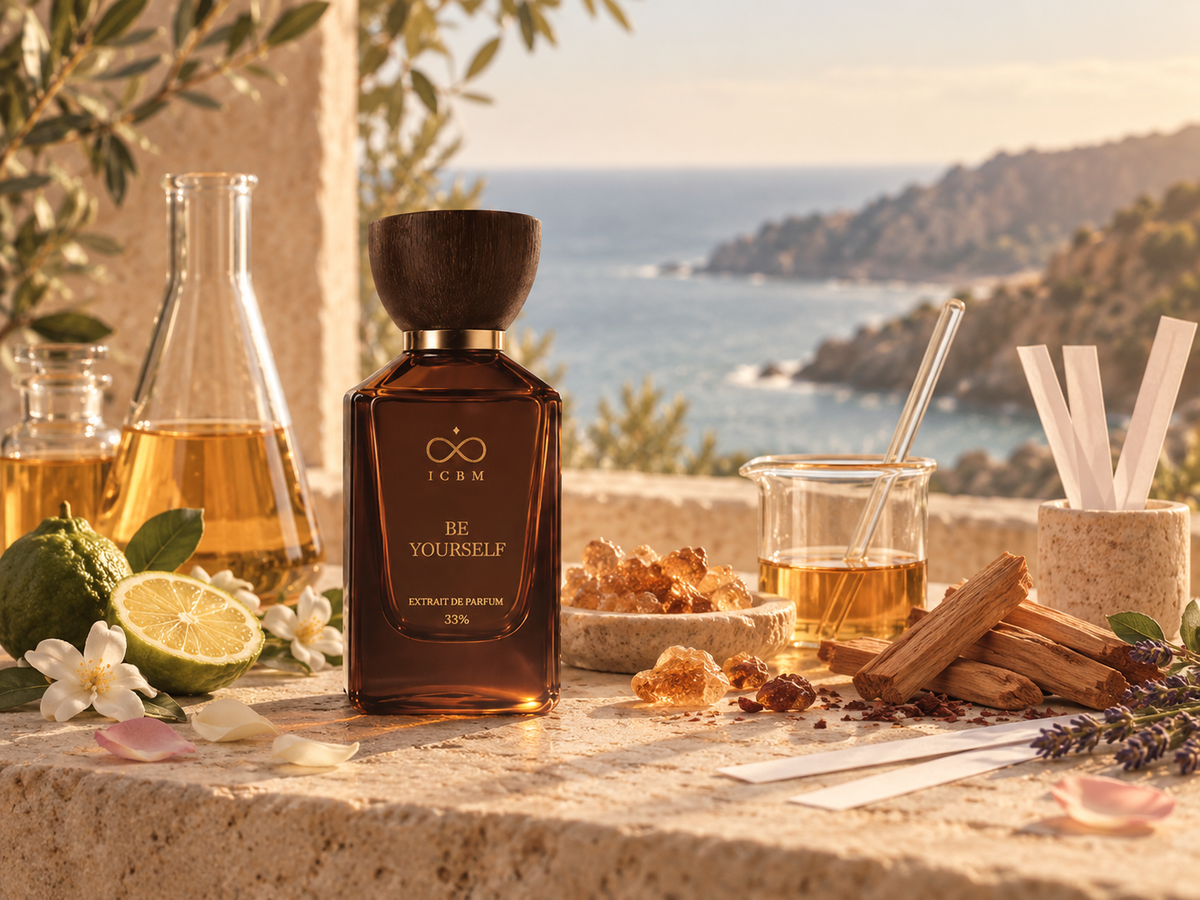
ICBM's first collection is built around three expressions.
Be Unstoppable.
Be Limitless.
Be Yourself.
Each represents a different way of moving through the world, but all begin from the same idea.
Fragrance can become part of how we express who we are at a particular moment.
That is where the perfume making process ultimately ends.
Not with the raw material.
Not with the formula.
Not with the alcohol.
Not even with the bottle.
It ends on the wearer.
Because the final ingredient in every perfume is the person who gives it meaning.
Frequently asked questions
How is perfume made?
Perfume is created by combining aromatic natural materials and aroma molecules into a carefully balanced fragrance concentrate. The formula is repeatedly evaluated and refined before being prepared at the intended concentration, rested and finished according to the production requirements of the fragrance.
What ingredients are used to make perfume?
Modern perfume can contain essential oils, absolutes, botanical extracts, woods, resins, balsams, spices, citrus materials, musks and manufactured aroma molecules. Fine fragrance frequently combines natural and modern materials.
What is the difference between perfume notes and perfume ingredients?
Perfume ingredients are the actual materials used in the formula. Notes are descriptions of the smells perceived by the wearer. A note can be created from several different ingredients working together.
What is a perfume accord?
A perfume accord is a combination of fragrance materials that creates a new unified olfactory effect. Accords are fundamental building blocks in perfume formulation.
Are natural perfume ingredients better than synthetic ingredients?
Not inherently. Natural extracts and aroma molecules have different strengths. Exceptional modern perfumery often combines both to achieve complexity, precision, diffusion, consistency and creative freedom.
What is extrait de parfum?
Extrait de parfum is a highly concentrated style of fragrance designed to provide a rich and substantial wearing experience. Concentration alone does not determine quality because the construction of the formula remains essential.
Does extrait de parfum last longer?
Higher fragrance concentration can contribute to persistence, but longevity also depends on the formula, materials, volatility, skin, climate and application. A higher concentration does not automatically guarantee greater projection or better quality.
What is perfume maceration?
In professional perfume production, maceration commonly refers to a controlled resting stage after fragrance concentrate has been combined with its alcoholic base. It allows the prepared fragrance system to integrate before later finishing and bottling stages.
What is perfume maturation?
Maturation is commonly associated with allowing a compounded fragrance concentrate to rest and integrate before subsequent production stages. Exact terminology and protocols can vary between manufacturers.
Does perfume get better the longer it macerates?
Not automatically. Appropriate resting can support integration, but time cannot repair a poorly balanced formula. The quality of the original composition remains fundamental.
What determines perfume longevity?
Longevity depends on the fragrance formula, concentration, materials, volatility, application, skin characteristics and environmental conditions.
What is perfume projection?
Projection describes how noticeably a fragrance radiates away from the wearer's skin.
What is perfume sillage?
Sillage refers to the scented trail or surrounding impression a fragrance creates as the wearer moves.
Why do perfumes smell different on different people?
Temperature, skin condition, application, environment and individual perception can affect how a fragrance is experienced. The underlying perfume remains the same, but its perceived development can vary.
What makes a perfume smell luxurious?
There is no single luxury ingredient. Material quality, balance, texture, transitions, controlled diffusion, refinement and overall composition can all contribute to an impression of luxury.
What is niche perfume?
Niche perfumery generally places fragrance itself at the centre of the creative identity, often giving greater emphasis to distinctive olfactory direction and specialist fragrance culture.
What is haute perfumery?
Haute perfumery describes an elevated approach to fragrance creation centred on artistic direction, sophisticated formulation, careful material selection and high levels of technical and olfactory refinement.
Is ICBM an Australian perfume house?
Yes. ICBM, I Can Be Myself, is an independent Australian fragrance house based in Brisbane, Australia, creating identity led fine fragrance through a combination of precious natural materials and modern perfumery.
Where can I learn more about perfume?
Explore the ICBM Journal to discover more about extrait de parfum, haute perfumery, precious fragrance materials, ingredient sourcing and the craft behind contemporary fine fragrance.
Three worlds. One you.
Be Unstoppable. Be Limitless. Be Yourself.