
Fragrance Families Explained: Floral, Woody, Amber, Gourmand and Beyond
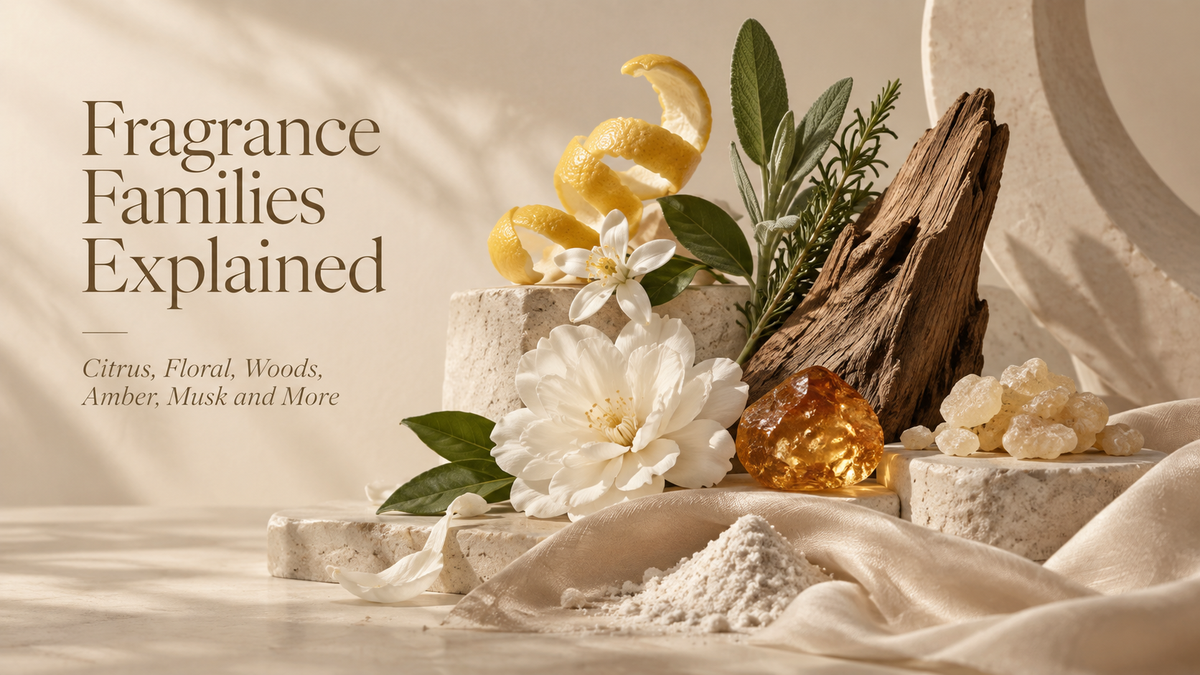
Walk into a fragrance store and the language can become confusing very quickly.
Floral.
Woody.
Amber.
Gourmand.
Fresh.
Aromatic.
Leather.
Musk.
Chypre.
Fougère.
These words appear everywhere in perfumery, yet they are often used without explaining what they actually mean.
A fragrance family is not simply a list of ingredients.
It is closer to a world.
A floral perfume can feel luminous and transparent, dark and velvety, green and botanical, or rich and sensual.
A woody perfume can feel creamy, dry, smoky, mineral or warm.
An amber perfume can feel soft and enveloping or intensely resinous and powerful.
And a gourmand fragrance can move far beyond sweetness into coffee, cocoa, roasted woods, bitter almond, smoke and spice.
Understanding fragrance families gives you a map.
But the map is not the destination.
The interesting part begins when those families overlap.
What are fragrance families?
Fragrance families are broad categories used to describe perfumes with similar overall olfactory characteristics.
They help organise an enormous perfume landscape into understandable territories.
Instead of trying to remember every material in a formula, fragrance families allow you to recognise the overall direction of a scent.
A perfume may be described as floral because flowers dominate its character.
Another may be woody because sandalwood, cedarwood, vetiver or other woody effects form its structure.
A gourmand perfume may suggest vanilla, coffee, cocoa, tonka or caramelised warmth.
An amber fragrance may feel resinous, warm, balsamic or enveloping.
The important word here is overall.
A perfume can contain rose without becoming a floral fragrance.
It can contain vanilla without becoming a gourmand perfume.
It can contain sandalwood without becoming primarily woody.
The family describes the larger composition, not one isolated ingredient.
Fragrance families are different from perfume notes
Perfume notes describe individual smells or impressions.
Fragrance families describe the broader character of the composition.
For example, a fragrance may list:
bergamot
rose
sandalwood
amber
musk
Those are notes.
But when combined, the fragrance might be classified as a woody floral, an amber floral or something more abstract depending on the balance.
This is why reading a note list alone rarely tells you exactly what a perfume will smell like.
Structure changes everything.
Floral perfume
Floral is one of the largest and most diverse perfume families.
It is also one of the most misunderstood.
Many people hear floral perfume and imagine one specific type of sweet flower scent.
In reality, floral perfumery can be almost anything.
Rose can smell fresh, dark, spicy, green or almost leathery.
Jasmine can feel luminous, creamy, sensual or intensely animalic.
Orange blossom can feel bright, clean, honeyed or narcotic.
Iris can become powder, suede, cool root, violet or polished wood.
Tuberose can feel creamy, tropical, green or dramatically sensual.
A modern floral fragrance may barely resemble a literal bouquet.
The perfumer may use flowers as texture, movement or contrast rather than attempting to recreate nature directly.
Who may enjoy floral fragrances?
Someone who enjoys elegance, luminosity, softness, sensuality or botanical complexity may naturally explore floral perfume.
But the only reliable way to know is to smell widely.
A person who believes they dislike floral fragrance may simply dislike one particular style of floral.
Woody perfume
Woody perfume is central to modern niche fragrance and contemporary fine fragrance.
Woody compositions can feel grounded, dry, creamy, smoky, warm, mineral or extremely diffusive.
Important woody materials and effects include sandalwood, cedarwood, vetiver, patchouli, oud and modern woody aroma molecules.
Sandalwood
Sandalwood can provide creamy warmth, smoothness and depth.
Some sandalwood materials feel soft and rounded.
Others are dryer, more radiant or more structured.
Cedarwood
Cedarwood can introduce dryness, warmth and architectural definition.
It can make a fragrance feel clean, polished or rugged depending on the composition.
Vetiver
Vetiver is one of perfumery's most complex roots.
It can suggest dry earth, smoke, wood, grapefruit, grass and mineral facets at the same time.
Oud
Oud can move through an enormous spectrum.
Dark wood.
Smoke.
Leather.
Fruit.
Resin.
Earth.
Animalic effects.
Balsamic warmth.
A modern oud fragrance may be powerful and dark or surprisingly smooth and transparent.
This is why two perfumes labelled oud can smell completely unrelated.
Amber perfume
Amber is one of the most important fragrance families in modern perfumery.
It is also frequently misunderstood.
Amber perfume usually refers to an olfactory construction rather than one single raw material.
The amber effect can be built using combinations of resins, balsams, vanilla style materials, woods, labdanum and modern amber molecules.
The result may feel:
warm
golden
resinous
sweet
dry
smoky
spicy
sensual
deep
Some amber fragrances are soft and skin like.
Others are dense and extremely powerful.
The best amber compositions balance warmth with structure so the fragrance does not become heavy or flat.
Gourmand perfume
Gourmand fragrance takes inspiration from edible smells and flavour associations.
Vanilla is perhaps the most famous gourmand note, but the category is far wider.
Coffee.
Cocoa.
Tonka.
Caramel.
Honey.
Almond.
Praline.
Roasted nuts.
Spices.
Even milk style and pastry effects can appear.
But gourmand perfume does not have to smell sugary.
A sophisticated gourmand can be dry, bitter, smoky or woody.
Coffee can become dark and roasted.
Vanilla can become resinous.
Cocoa can become almost leathery.
Tonka can create warmth without obvious sweetness.
The most compelling gourmand fragrances often contain tension.
Something delicious.
Something unexpected.
Citrus perfume
Citrus fragrance creates some of perfumery's brightest and most immediate effects.
Common citrus materials include bergamot, lemon, grapefruit, mandarin and orange.
Bergamot
Bergamot can smell fresh, floral, aromatic and slightly bitter.
It is one of the most versatile opening materials in fine fragrance.
Lemon
Lemon provides brightness and sharp freshness.
Grapefruit
Grapefruit can feel tart, dry, sparkling and slightly bitter.
Mandarin
Mandarin often feels softer and rounder.
Because many citrus materials are highly volatile, they can create a vivid opening but may fade relatively quickly.
The challenge is building a fragrance beneath the citrus so the brightness evolves rather than simply disappearing.
Fresh perfume
Fresh perfume is not one strict technical family.
It is a broad consumer description covering several fragrance styles that feel clean, bright, airy or energetic.
Freshness can come from:
citrus
green notes
aromatic herbs
aquatic effects
light florals
cool woods
clean musks
A fresh fragrance does not need to be weak.
Modern perfumery can create very diffusive fresh perfumes with significant longevity.
Freshness describes the sensation.
Not the strength.
Green perfume
Green fragrance suggests living vegetation.
Crushed leaves.
Stems.
Grass.
Herbs.
Cool botanical textures.
Green materials can create sharpness, bitterness, naturalism and contrast.
A green element can stop floral perfume from becoming overly sweet.
It can make fruit feel less edible.
It can give woody perfume more energy.
Green fragrance often feels particularly modern because it introduces something raw and alive into polished perfume architecture.
Aromatic perfume
Aromatic fragrance commonly uses herbal materials and fresh botanical effects.
Lavender, rosemary, sage and other aromatic materials often appear.
Aromatic perfume can feel:
fresh
clean
herbal
dry
energetic
cool
masculine in traditional styling
completely unisex in modern styling
Many contemporary perfumes combine aromatic freshness with citrus, woods, amber or musk.
Fougère fragrance
Fougère is one of classical perfumery's most important structures.
The word means fern in French.
But a fougère does not literally smell like fern.
Traditional fougère architecture is generally associated with lavender style freshness, aromatic materials, coumarin warmth and mossy or woody foundations.
The effect can feel clean, structured and elegant.
Modern fougère fragrances can be highly traditional or radically contemporary.
Many are now designed as unisex perfumes rather than following older gender conventions.
Fougère is best understood as an architecture.
Not a single ingredient.
Chypre fragrance
Chypre is another classical fragrance structure.
Traditional chypre perfume combines a bright opening with a darker, woody and mossy foundation.
The contrast is the important part.
Light against shadow.
Freshness against depth.
Floral or fruity effects against dry woods.
Modern material restrictions and changes in perfumery have transformed the exact construction of chypre fragrances, but the style remains influential.
Chypre perfume often feels sophisticated, dry, elegant and structured.
Musk perfume
Musk is essential to modern perfumery.
Traditional animal musk is no longer the basis of mainstream contemporary musk fragrance.
Modern perfumers work primarily with manufactured musk molecules capable of creating very different effects.
Some musks feel clean.
Some are powdery.
Some are warm.
Some resemble soft skin.
Some are airy and almost transparent.
Others create considerable diffusion.
This is why a musk fragrance may feel intimate while still remaining present for many hours.
Musk is not only a note.
It can influence texture, volume, continuity and perfume longevity.
Leather perfume
Leather is usually an accord.
The perfumer builds the impression of leather using several materials rather than extracting literal leather.
Leather fragrance can feel:
dark
smoky
dry
polished
suede like
animalic
woody
soft
A leather perfume combined with iris can become elegant and tactile.
Leather with oud may become darker.
Leather with rose can create contrast between softness and structure.
Leather with amber can become warm and luxurious.
It is one of perfumery's most expressive families.
Fruity perfume
Fruity fragrances use impressions such as peach, pear, plum, apple, apricot, berries, fig and tropical fruits.
But fruity perfume does not necessarily mean sweet perfume.
Fruit can be:
green
tart
juicy
dark
fermented
creamy
dry
Some materials naturally cross boundaries.
Osmanthus, for example, can evoke apricot while also possessing floral and leather like facets.
That kind of complexity is exactly why fragrance families overlap so naturally.
Aquatic and marine perfume
Aquatic fragrance became a major modern perfume territory through developments in aroma chemistry.
These fragrances can evoke water, sea air, salt, cool minerals and transparent freshness.
An aquatic fragrance may feel:
clean
airy
marine
watery
mineral
cool
ozonic
Modern aquatic perfume does not need to smell conventionally blue.
Used carefully, aquatic materials can create space and lift inside a much more sophisticated composition.
Spicy perfume
Spices can dramatically change the energy of a fragrance.
Cardamom.
Pepper.
Cinnamon.
Clove.
Nutmeg.
Saffron.
Spices can feel warm or cool.
They can make woods more vibrant.
They can deepen amber fragrance.
They can sharpen florals.
They can transform gourmand notes into something darker and more adult.
Spice is often used as tension inside another fragrance family rather than as the entire identity.
Powdery perfume
Powdery perfume is another category that is often better understood as a texture.
Powdery effects may come from iris, violet, heliotrope, musk, vanilla and other materials.
They can evoke:
cosmetics
soft fabric
skin
makeup powder
violet
almond
cool root
A powdery perfume can feel nostalgic and vintage.
Or extremely modern and minimal.
Again, architecture decides the result.
How fragrance families overlap
This is where perfume becomes truly interesting.
Very few sophisticated fragrances belong perfectly to one isolated family.
A perfume might be:
floral woody
woody amber
amber gourmand
leather floral
citrus aromatic
woody musk
oud rose
green floral
spicy amber
fruity chypre
Families behave more like colours than boxes.
Blue and yellow can exist separately.
But together they create another world.
Fragrance works in the same way.
The most memorable perfumes often exist between categories.
Why the same fragrance family can smell completely different
Imagine three woody perfumes.
One is built around creamy sandalwood and soft musk.
Another uses smoky vetiver and dry cedar.
The third combines oud, amber and leather.
All three are woody fragrances.
Yet emotionally they could feel completely different.
The same thing happens with floral perfume.
A rose and musk composition can feel soft and intimate.
Rose, oud and leather can feel dark and commanding.
Rose with citrus and green materials can feel luminous and almost transparent.
The family only tells you where the journey begins.
It does not tell you where the perfumer will take it.
How to find your fragrance family
Instead of beginning with a brand name, start with how you want to feel.
Ask yourself:
Do I prefer bright or dark fragrances?
Do I like dry perfume or sweet perfume?
Do I want something soft or powerful?
Do I enjoy clean scents or more sensual ones?
Do I prefer nature, woods and botanicals?
Do I enjoy edible and comforting smells?
Do I like smoke, leather and resin?
Your answers will usually point toward several fragrance families rather than one.
Someone who enjoys darkness, smoke and depth may naturally explore woody, amber and leather perfumes.
Someone who enjoys brightness and clarity may gravitate toward citrus, aromatic and green fragrances.
Someone attracted to softness and texture may explore musk, floral and powdery fragrance.
Someone interested in warmth and edible effects may enjoy amber and gourmand perfume.
What perfume suits me?
This is one of the most common questions in fragrance.
There is no universal formula.
Perfume is too personal for that.
But fragrance families can narrow the field.
Think about smells you already enjoy outside perfume.
Fresh citrus.
Old books.
Wood.
Coffee.
Flowers.
Rain.
Leather.
Vanilla.
Herbs.
Incense.
Sea air.
These preferences can reveal patterns.
Then test perfumes on your skin.
Not just on paper.
The goal is not to find the fragrance other people say should suit you.
The goal is to discover what you repeatedly want to smell again.
Fragrance and personality
Perfume can express personality.
But it does not need to describe you literally.
A quiet person can wear an enormous amber fragrance.
A confident person may choose an intimate musk.
Someone who usually wears woody perfume may suddenly want a luminous floral.
Fragrance can represent who you are.
It can also represent another part of yourself that you want to explore.
That freedom is one of perfume's greatest qualities.
Unisex perfume and fragrance families
Fragrance families are not biologically male or female.
Woods do not have a gender.
Rose does not have a gender.
Vanilla does not have a gender.
Leather does not have a gender.
Musk does not have a gender.
Traditional perfume marketing often divided these materials into masculine and feminine categories.
Modern niche perfume increasingly ignores those limitations.
A fragrance can simply be worn by the person who connects with it.
This is central to the ICBM philosophy.
Identity should not need permission.
Niche perfume and fragrance families
Niche perfume often takes familiar fragrance families and changes the rules.
A floral fragrance may become mineral.
A gourmand may become bitter.
A musk may become abstract.
A woody perfume may feel almost transparent.
A leather fragrance may become soft suede.
An oud composition may focus on fruit and warmth rather than darkness.
The familiar family helps orient the wearer.
The creative interpretation makes the fragrance memorable.
What makes a fragrance smell luxurious?
No fragrance family is automatically luxurious.
Luxury perfume can be floral, woody, citrus, gourmand or musk.
The difference comes from execution.
Material quality.
Balance.
Texture.
Diffusion.
Proportion.
Clarity.
Development.
Craftsmanship.
And restraint.
A fragrance containing twenty rare materials can still feel confused.
A relatively simple structure can feel extraordinary when every element belongs.
Luxury is not created by the family name.
It is created by how beautifully that family is expressed.
Why perfume ingredients matter
Fragrance families are concepts.
Ingredients make those concepts real.
A woody composition depends on the specific woods and woody molecules selected.
A floral perfume depends on the quality and character of the floral materials.
A citrus perfume can change dramatically depending on the type and quality of bergamot, lemon, grapefruit or mandarin used.
The same material name can describe products with different origins, processing methods, purity and olfactory characteristics.
That is why careful perfume ingredient sourcing matters.
At ICBM, materials are selected for what they contribute to the complete fragrance rather than simply because their names sound luxurious.
The material must have a reason to exist.
Natural ingredients and aroma molecules
Fine fragrance is not a battle between nature and chemistry.
Modern perfumery can use both.
Natural materials bring extraordinary complexity.
A rose absolute may contain many dimensions.
A natural vetiver can shift from earth to smoke to citrus like facets.
Resins can offer depth and texture.
Modern aroma molecules bring another set of possibilities.
Radiance.
Precision.
Diffusion.
Persistence.
Transparency.
Effects that may not exist naturally.
The perfumer's job is not to choose sides.
It is to choose what makes the composition better.
Fragrance families and perfume performance
Different fragrance families can also create different expectations around longevity, projection and sillage.
Bright citrus perfumes may feel immediately radiant because many citrus materials are relatively volatile.
Woody, amber, musk and resinous structures can contain more persistent materials.
But these are tendencies.
Not guarantees.
A sophisticated fresh fragrance can last for many hours.
A dense amber perfume can remain surprisingly close to skin.
Perfume performance depends on the architecture of the entire formula.
Fragrance families in Australian perfumery
Australia offers an interesting perspective on contemporary fragrance.
Its botanical landscape includes distinctive woods, aromatic materials and natural textures that can contribute to modern fine fragrance.
For an Australian perfume house, the opportunity is not simply to create something that smells literally Australian.
It is to combine local identity with international perfumery language.
Australian materials can exist beside rose, iris, oud, musk, amber and modern aroma molecules.
Geography becomes inspiration rather than limitation.
The ICBM approach
At ICBM, we do not believe a fragrance needs to fit perfectly inside one category.
Fragrance families are useful.
Identity is more complicated.
A perfume can contain contradiction.
Softness and strength.
Brightness and darkness.
Nature and technology.
Familiarity and surprise.
That is often where something distinctive appears.
We begin with the identity of the fragrance.
Then we choose the materials, structure and family relationships required to express it.
The objective is not to create a perfume that merely smells recognisable.
It is to create one that feels personal.
Fragrance families are a map, not a rule
When you begin exploring perfume, fragrance families are incredibly useful.
They help you understand what you smell.
They help you compare fragrances.
They help you recognise patterns in your own taste.
But eventually, the categories should disappear.
You stop thinking:
This is woody.
This is floral.
This is amber.
And you begin thinking:
This feels like me.
That is the point.
Perfume is not ultimately about categorising smells.
It is about discovering the ones you do not want to forget.
Frequently asked questions
What are the main fragrance families?
Common fragrance families include floral, woody, amber, citrus, aromatic, green, gourmand, musk, leather, fruity, aquatic, fougère and chypre. Different classification systems may organise them differently.
What is a floral perfume?
A floral perfume is a fragrance in which floral impressions such as rose, jasmine, orange blossom, iris or other flowers play a major role.
What is a woody perfume?
A woody perfume emphasises woody materials and effects such as sandalwood, cedarwood, vetiver, patchouli, oud and modern woody aroma molecules.
What is an amber perfume?
Amber perfume generally describes a warm, resinous and enveloping style built from materials such as balsams, resins, vanilla style notes, woods and modern amber molecules.
What is a gourmand perfume?
A gourmand perfume uses edible inspired notes such as vanilla, coffee, cocoa, tonka, caramel, honey or almond.
What is a fresh perfume?
Fresh perfume is a broad description for fragrances that feel bright, clean or airy. Citrus, green, aquatic, aromatic and light floral materials can all create freshness.
What is musk perfume?
Musk perfume uses modern musk materials to create effects ranging from clean and airy to warm, powdery and skin like.
What is a leather fragrance?
Leather fragrance recreates the smell or texture of leather through an accord of several fragrance materials.
What is a chypre perfume?
Chypre is a classical perfume structure built around contrast between a bright opening and a darker woody or mossy foundation.
What is a fougère perfume?
Fougère is a classical aromatic structure traditionally associated with lavender style freshness, coumarin warmth and woody or mossy foundations.
What is an aquatic fragrance?
Aquatic fragrance uses marine, watery, mineral or ozonic effects to suggest water, sea air or transparent freshness.
Which fragrance family lasts longest?
No family automatically lasts longest.
Longevity depends on the specific materials, concentration and formula architecture, although woody, amber, musk and resinous materials can often contribute persistence.
Which perfume family is best for summer?
Many people enjoy citrus, fresh, green, aromatic and aquatic fragrances in warm weather, but personal preference is more important than seasonal rules.
Which perfume family is best for winter?
Woody, amber, gourmand, leather, spicy and resinous perfumes are often popular in cooler weather because richer structures can feel comfortable in lower temperatures.
What perfume suits me?
Start by identifying fragrance families and textures you already enjoy, then test different perfumes on skin and observe which ones you repeatedly want to smell again.
Can one perfume belong to several fragrance families?
Yes.
Many perfumes combine families, such as woody floral, amber gourmand, citrus aromatic or leather floral.
Are niche perfumes unisex?
Many niche perfumes are marketed as unisex, but fragrance itself has no inherent gender.
Any fragrance family can be worn by anyone.
Finding your fragrance world
The first time you explore perfume, fragrance families can feel like categories.
Later, they begin to feel more like directions.
Floral can become texture.
Wood can become structure.
Amber can become warmth.
Musk can become skin.
Citrus can become light.
Leather can become confidence.
Gourmand can become memory.
And somewhere between all those worlds, you begin to recognise your own taste.
That is when fragrance stops being a list of ingredients.
It becomes personal.
Three worlds. One you.
Be Unstoppable. Be Limitless. Be Yourself.